
A heavy snowstorm rearranges the geography of New York. Corners change shape. Curb lines vanish. The plows arrive first, clearing the streets with a kind of municipal efficiency and pushing the snow outward to the edges, where it gathers along the curb in ridges and barricades that were not there the day before.
Within a day the block has acquired a new topography. Hollows appear where tires have spun and failed. Frozen walls rise where the plows have passed. Pedestrians begin to trace new paths along the sidewalks, stepping around obstacles that did not exist a few hours earlier.
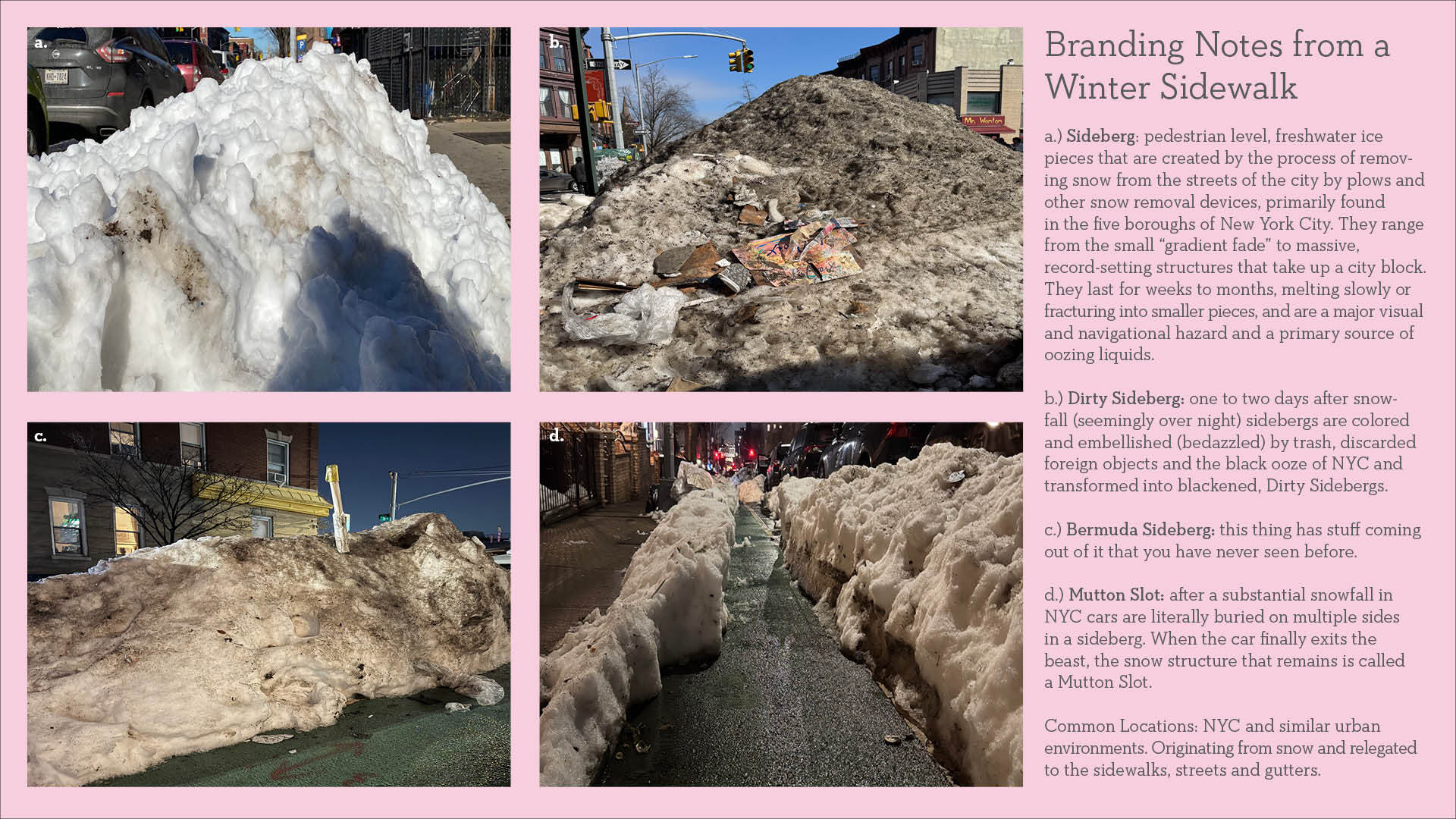
Standing there in the street after the storm, I noticed one formation in particular. A mound of displaced snow along the curb would harden, darken, and settle into something oddly permanent. It acquired mass and personality. It blocked hydrants. It swallowed bumpers. It forced pedestrians into awkward detours.
The thing needed a name. It became the Sideberg.
The Sideberg is the urban cousin of the iceberg. It begins as nothing more than displaced snow but quickly evolves into a structure of surprising durability. In a serious winter it can remain for weeks, compacted by passing traffic and reinforced by successive dustings of snow that seal the whole formation into a single frozen block.
Under the streetlights the fresh snow can look almost sculptural. Give it a day or two. New York soon contributes its own materials. Coffee cups, candy wrappers, cigarette packs, fragments of newspaper, the occasional unidentifiable object, and above all the black residue that seems to seep from every winter gutter slowly embed themselves in the surface.
What remains is no longer snow in any sentimental sense. It becomes something else entirely: the Dirty Sideberg.
The city produces other formations as well. When a parked car finally breaks free from the frozen barricade the plows have built around it, the result is a curious cavity in the drift. The void has the unmistakable look of an archaeological discovery, as though a fossilized sedan has just been excavated from the street.
With a little imagination…this cavity became the Mutton Slot.
Some Sidebergs develop an air of mystery. One in particular, near the corner of my office in Manhattan, began collecting objects that had no clear origin.
I came to think of this one as the Bermuda Sideberg.
The mound seemed to swallow objects and release them again days later as the ice shifted and settled. Half a traffic cone, a glove, the rib of a broken umbrella and the corner of a plastic crate. Watching it over time felt less like observing weather than examining a frozen archive of the block. Each thaw revealed some new artifact as though from a neighborhood excavation dig.
It occurred to me that this small exercise in sidewalk taxonomy had a long human desire for control and order. Scientists name plants and planets. Sailors once named every variation of wind and wave. Mountaineers gave names to ridgelines, crevasses, and passes. Arctic explorers catalogued the varieties of ice with extraordinary precision.
The act is instinctive. Naming is the human habit of imposing order on a world that often feels random and sometimes chaotic.
A snowstorm can paralyze the city. Streets close, schedules collapse, movement slows to a crawl. Yet once the phenomena have been noticed and named, they begin to feel slightly less chaotic. The namer has drawn a small boundary around the event. The storm still exists, but it now contains recognizable features.
The winter geography does not last. A warm week arrives and the Dirty Sidebergs soften—at this point all Sidebergs are Dirty—sag, and ooze slowly into the gutter. The Mutton Slots collapse. The Bermuda Sideberg releases its inventory and dissolves into gray slush that flows toward the drains.
Before long the streets return to their ordinary shape.
Until the next storm arrives.
Then the plows pass again. Snow piles up along the curb. Pedestrians adjust their routes. And the namer standing on the sidewalk recognizes the familiar formation almost immediately.
Another Sideberg.